Licensed industrial painters
Industrial Painting & Coatings in Adelaide & South Australia
Industrial painting and coatings covers warehouses, factories, plant rooms, workshops, structural steel, tanks, pipework and machinery. It is work for facility managers, engineers, builders and business owners who need surfaces protected against corrosion, chemicals, heat and heavy use, not just made to look tidy. SA Painting Professionals specifies and applies coating systems to suit the exposure, prepares steel and concrete properly, and schedules the work around production so your site keeps running while the coatings go on.
- Licensed and insured
- Free itemised quotes
- Trade-quality paints
What's included
- Site assessment and coating specification
- Steel preparation
- Concrete and masonry preparation
- Multi-coat protective systems
- Access equipment and working at heights
- LicensedLicensed & fully insured
- FreeItemised, no-obligation quotes
- 1,890+SA suburbs & localities serviced
- Trade-qualityPaints and coatings on every job
Overview
Industrial Painting & Coatings done properly
Industrial painting is a different job from painting a house. The surfaces are steel, galvanised metal, precast and blockwork, concrete floors and old coatings that have already failed once. The environment adds moisture, chemicals, forklift traffic, wash-downs and heat from plant. A coating that is fine on a shopfront will lift off a wash-bay wall inside a year. So the work starts with the exposure: what the surface is, what it is exposed to, and how long the coating needs to last before the next shutdown. From that we specify a system, usually a primer, a build coat and a topcoat, chosen to work together and applied at the film thickness the manufacturer calls for.
Typical jobs include repainting warehouse walls and ceilings, recoating structural steel columns, beams and purlins, protecting tanks, handrails, stairs and pipework, sealing and coating concrete floors, and colour-coding plant and safety zones. For steel we work to AS/NZS 2312.1:2014, the Australian guide to protective coating systems against atmospheric corrosion, which sets out preparation grades and system choices for each environment. Coastal sites on the Yorke and Eyre Peninsulas, near Port Adelaide or along the Limestone Coast sit in more corrosive categories than a dry inland shed, and the primer and topcoat are chosen accordingly.
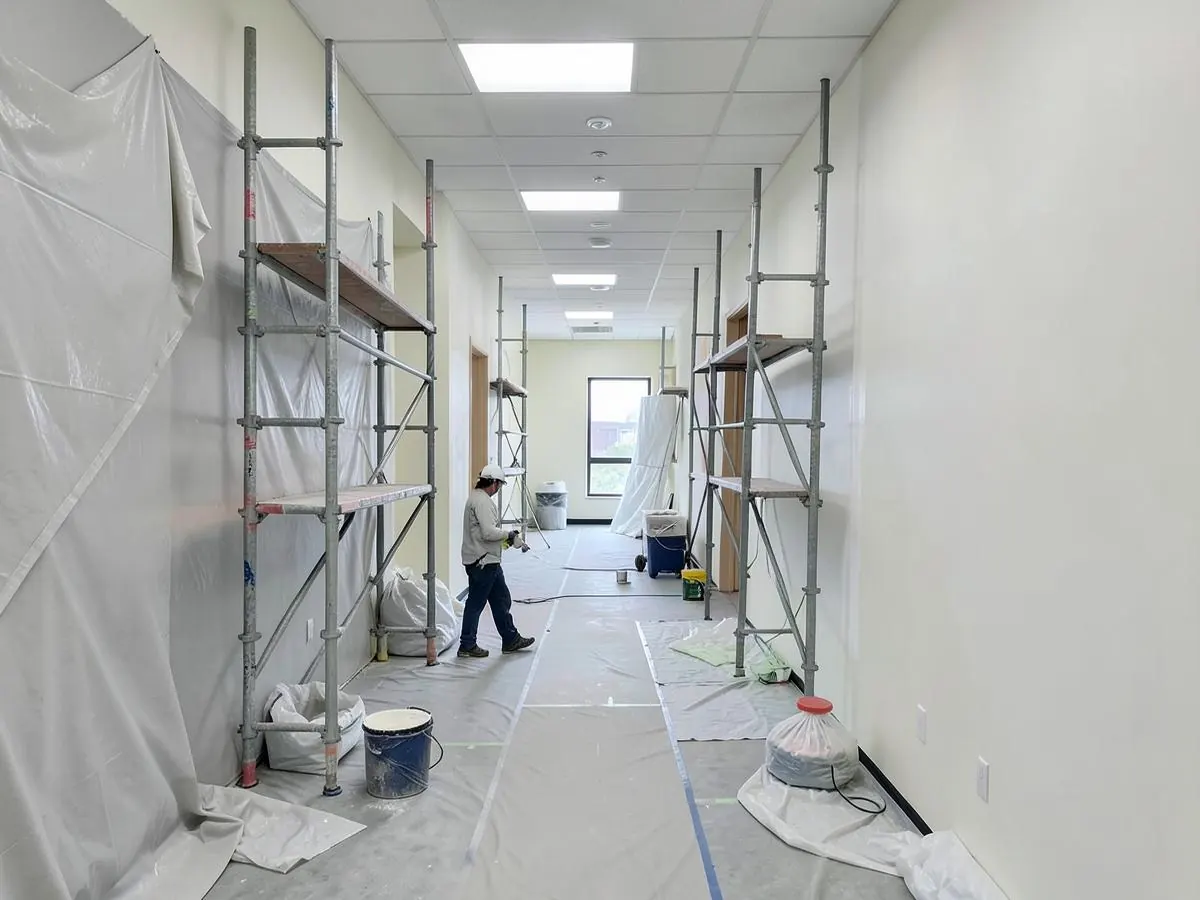
Good industrial work looks even and consistent, but the quality is mostly in what you cannot see: sound preparation, correct film build and coats applied within the recoat windows. We measure wet and dry film thickness as we go and record it where a specification asks for it. Scheduling is planned around your operation. That can mean working in a shutdown window, painting one bay at a time while the rest of the floor stays live, or working nights and weekends. Plant and stock are covered, walkways are barricaded and signed, and the area is handed back clean and safe for the next shift.
Get a quote for industrial painting
Send a few photos or book a site visit. We reply within one business day with a free, itemised written quote and no obligation.
Request a quoteWhat's included
What our industrial painting service includes
The work that goes into the job before, during and after the paint goes on. Every item is spelled out on your quote.
Site assessment and coating specification
We inspect the substrate, check existing coatings for adhesion and note the exposure: moisture, chemicals, heat, traffic and coastal salt. From that we recommend a system with primer, build coat and topcoat, or work to a specification supplied by your engineer or facility manager.
Steel preparation
Rust, mill scale and failed paint are removed by power tool cleaning, needle gunning or abrasive blasting to the preparation grade the system needs. Surfaces are degreased, edges and welds are ground back and the steel is primed before flash rusting can take hold.
Concrete and masonry preparation
Floors are degreased, diamond ground or shot blasted to open the surface, and cracks and spalls are repaired with epoxy mortar. Blockwork and precast walls are pressure washed, treated for mould or efflorescence, and sealed so the topcoat bonds and covers evenly.
Multi-coat protective systems
Each coat is applied by airless spray, roller or brush at the wet film thickness the data sheet calls for, and the next coat goes on inside the recoat window. Dry film thickness is checked with a gauge and recorded where your specification requires it.
Access equipment and working at heights
Scissor lifts, boom lifts and scaffold are arranged for high walls, roof structure, gantries and racking. Our painters hold the relevant tickets, work to a safe work method statement and complete your site induction before anyone starts.
Protection of plant, stock and people
Machinery, conveyors, racking and stock are masked or sheeted before spraying starts. Work zones are barricaded and signed, overspray is controlled, and ventilation and low-odour products are used where staff keep working nearby.
Safety colours and demarcation
Bollards, handrails, stair nosings, pipework, pedestrian walkways and exclusion zones are painted in the safety colours your site uses, so hazards are visible and traffic and people are kept apart. Floor markings use hard-wearing epoxy or polyurethane paints.
Clean-up and handover
Masking comes off, waste and empty drums are removed, and the area is swept and left ready for use. You receive a summary of the products applied, the batch numbers where required and the recommended cure time before plant or traffic returns.
Our process
How we approach industrial painting
From first contact to the final walk-through, this is how a job runs with us.
- Step 01
Enquiry and site inspection
Send us the site details, plans or photos and we will reply within one business day. For metro Adelaide we inspect on site; for regional sites we often price from drawings and photographs first and confirm on a visit. We check substrates, access and how the site operates.
- Step 02
Specification and itemised quote
You receive a free, itemised quote that names the coating system, the preparation method, the number of coats and the access equipment. If your engineer has issued a specification we price to it; if not, we recommend a system suited to the exposure and explain why.
- Step 03
Program and site set-up
We agree a program that fits your production, whether that is a shutdown, staged bays, nights or weekends. Inductions, safe work method statements and permits are completed, access equipment is delivered and the work zone is barricaded and protected before preparation starts.
- Step 04
Preparation
Steel is cleaned or blasted, concrete is ground or washed, and repairs are made. Preparation is usually the largest part of an industrial job and is not rushed, because the coating system only performs on a surface prepared to the grade it was designed for.
- Step 05
Coating application
Primer, build coats and topcoats are applied in sequence within the recoat windows, with film thickness checked as we go. Temperature and humidity are monitored, since most industrial coatings will not cure properly on cold, damp mornings or on steel that is too hot in summer.
- Step 06
Inspection and handover
We walk the job with you, check film build and coverage against the specification, remove all protection and waste, and confirm when the area can return to service. Cure times for floors and chemical-resistant systems are stated clearly so nobody drives on them early.
Materials
Coating systems we use
Industrial coatings are chosen as a system, primer through topcoat, matched to the substrate and the exposure it faces.
Zinc-rich and epoxy primers for steel
Zinc-rich primers give steel sacrificial protection in corrosive and coastal environments, while epoxy primers bond hard to blasted or power-tool-cleaned steel. Both are used as the first coat under an AS/NZS 2312.1 system and are chosen by the corrosivity category of the site.
High-build epoxy build coats
Two-pack epoxies build film thickness quickly and resist chemicals, oil, abrasion and wash-down. They are the workhorse mid coat on steel, tanks and plant, and the main coat on concrete floors. Epoxies chalk in direct sun, so exterior work gets a UV-stable topcoat over them.
Polyurethane topcoats
Two-pack polyurethanes hold colour and gloss outdoors and shrug off UV, which is why they finish most exterior steel, external tanks and plant that sits in the South Australian sun. Inside, they give floors a hard, cleanable wearing surface over an epoxy base.
Epoxy and polyurethane floor systems
Warehouse and workshop floors get a penetrating epoxy primer, one or two high-build epoxy coats and, where forklifts or chemicals are involved, a polyurethane wearing coat. Anti-slip aggregate is broadcast into ramps, wash bays and walkways to meet the slip resistance the area needs under AS 4586.
Heat-resistant and chemical-resistant coatings
Silicone-based heat-resistant paints handle exhausts, boilers and hot pipework where standard enamels would discolour and flake. Novolac epoxies and vinyl esters line bunds, sumps and tanks holding acids, solvents or fuels. Both are specified from the data sheet against the actual temperature or chemical.
Intumescent fire-protective coatings
Intumescent coatings swell under heat to insulate structural steel and are applied to the thickness set by the engineer for the required fire rating. They are specified by engineers and certifiers, not chosen off the shelf, and we apply and document them to that specification.
APAS-approved and trade brands
Where a specification calls for APAS-approved products we supply them and name them on the quote. Our systems come from the major Australian industrial ranges, such as Dulux Protective Coatings and Wattyl, and every product is applied to its own data sheet for thinning, film build and recoat times.
Pricing
What affects the price of industrial painting
Every quote is itemised, so you can see exactly where the money goes. These are the factors that move the number most.
Want a number for your job?
No two surfaces are in the same condition, so we quote each job properly rather than guessing. Send photos or book a site visit and we reply within one business day.
Get a free quote- 01
Preparation grade
Abrasive blasting to bare metal costs more than power tool cleaning, and heavily rusted or previously failed coatings need more of it. The preparation grade the system requires is the biggest single driver on most steel jobs.
- 02
Area and complexity of the steelwork
Flat wall area is quick to spray. Lattice trusses, purlins, pipework, handrails and bolted connections have far more surface per metre and take longer to prepare and coat, so the shape of the steel matters as much as the size.
- 03
Coating system and number of coats
A three-coat AS/NZS 2312.1 system for a coastal site uses more expensive products and more labour than a two-coat system in a dry shed. Polyurethane topcoats, chemical-resistant linings and intumescents sit at the higher end.
- 04
Access and height
Boom lifts, scissor lifts and scaffold are hired for the duration of the job, and high roof structure or confined spaces slow the work. Clear floor space for access equipment reduces both hire and labour time.
- 05
Working around production
Painting during a full shutdown is the most efficient. Staged work, night shifts, weekend work and repeated set-up and pack-down around a live operation add hours, and permit or induction requirements on larger sites add time too.
- 06
Containment and environmental controls
Blasting and spraying near other plant, stock, neighbours or waterways may need containment sheeting, dust extraction and waste handling. Lead-based or chromate primers on older steel need controlled removal and disposal.
- 07
Location
Regional and remote sites across South Australia add travel and accommodation, which we itemise in the quote. Grouping several tasks into one visit, such as steel, floors and line marking together, usually works out better than separate trips.
FAQ
Industrial Painting & Coatings questions
Straight answers to the questions we hear most about this service.
What is AS/NZS 2312.1 and does my job need it?
Can you paint while our site keeps operating?
Do you need to blast the steel back to bare metal?
How long before we can drive forklifts on a new epoxy floor?
Can you apply intumescent or fire-rated coatings?
Do you work on regional and coastal sites?
What paperwork do you provide at the end of the job?
More from us
Other painting services
Service areas
Where we offer industrial painting
Adelaide based and servicing all of South Australia, from the CBD and suburbs to the Hills, the coast and the regions. Choose your region to find your suburb page, or search for your suburb directly.
Ready to talk about industrial painting?
Free, itemised quotes for homes and businesses across Adelaide and all of South Australia. Send the quote form and we will be in touch within one business day.